I
received my primary education at the Moscow Hydrometeorological
College. The institution, as it was known then, no longer exists.
Today, searching for "Moscow Hydrometeorological College" yields
unclear results and a website (mgmtmo.ru) that bears little resemblance
to the college I remember. The current online presence is
underwhelming, though one cannot expect students to be responsible for
its revitalization.
|
|
I was fortunate
to have studied there for four years and, a decade later, after
obtaining a higher education, to return as a teacher in my field of
study. This unique perspective allows me to draw comparisons between my
time as a student and as an instructor.
|
|
|
|
Beginning
the Story.
|
|
I typically
write my memoirs by hand with a pen, revising and adding details later.
This process is excellent memory training, often bringing new details
to light. I began writing about 40 years ago during mountain hikes. My
most detailed notes are from my work as a rescuer after the earthquake
in Spitak, Armenia, which will be a separate chapter as it occurred
during my teaching tenure at the college.
|
|
Why This
College?
|
|
I enrolled in
1970. My choice was straightforward: my grandmother's neighbour,
Antonina Stepanovna Slepneva, was the head of the administrative and
economic department at the college. Following my lead, neighbours
Sergey and Vitya Chernushkin also enrolled. I chose the radio
technician specialty due to my interest in electronics.
|
|
The admission
process in early July was lively, with music playing and a great
atmosphere. Entrance exams in August included mathematics and an essay.
Upon learning of my acceptance, I felt a mix of emotions, perhaps
hesitant to leave school behind.
|
|
Before
September 1, we participated in chores, where I met Sasha Efimov, my
future classmate. Our first task was painting the flagpoles in front of
the technical school.
|
|
A New Life
Begins.
|
|
College was
different from school; our group started with 28-25 students, a number
that dwindled after the winter session as some were expelled.
|
|
The faculty
left a lasting impression:
Alla Valeryevna Ponomareva: Our kind homeroom teacher.
Yakov Abramovich Kletsel - Mathematics.
Galina Mikhailovna Rumyantseva - Physics.
Vladimir Vasilyevich Shibaev - Physical Education.
Zoya Mikhailovna Chudnovskaya - Literature/Russian, an excellent
teacher with memorable speech.
Alexei Egorevich Maidanov - A major who taught Initial Military
Training (NVP).
|
|
The first year
was successful. Winters were harsh, and PE classes were cross-country
skiing through the Kuchinsky forest around the Hare Lakes, which have
since been excavated to form Hare Lake.
|
|
After the
spring session, we had military training at the college's hydrological
base in Omutishchi. We dug trenches, ran night cross-country in gas
masks, and ended with a river crossing of the Klyazma, insured by Major
Maidanov in a boat. He often shared stories from his service in
counterintelligence and Khrushchev’s guard.
|
|
Winter holidays
included a sports camp in Omutishchi. For 11 rubles, we spent 10 days
skiing 10-15 kilometers daily, cooking for ourselves, and enjoying the
community. Teachers Yuri Sergeevich Verle and another (whose name I
regrettably cannot recall) accompanied us.
|
|
The first year
concluded with practical work in the mechanical workshops located in
the basement of an old dormitory, where we learned hands-on skills with
lathes and milling machines.
|
|
The college
emphasized sports, with strong skiing and cycling tourism clubs. On May
holidays, we cycled from Kuchino to Zagorsk (now Sergiev Posad), a
three-day trip that included visiting the Trinity Lavra of St. Sergius.
|
|
The Second
Year
|
|
The second year
began with the Soviet tradition of student labor mobilizations, where
students were sent to harvest potatoes, this time near Voskresensk. We
stayed in a village house and, in a memorable incident, helped a
neighbour for a ruble each, which we immediately spent on cognac. The
work paid little (20-25 rubles), and it later emerged that teachers had
mishandled funds, leading to legal consequences for some.
|
|
New subjects
were introduced:
Electrical Engineering - Taught by Lyudmila Ivanovna Yegarmina.
Electronic Devices - Taught by Patokin.
The college was a hub of activity until late, with volleyball,
ping-pong, and open laboratories.
|
|
After classes,
Sasha Efimov and I often went skiing. The winter sports camp in
Omutishchi remained a highlight, and the college regularly held tourist
rallies, which sparked my interest in orienteering after our group won
first place. This passion for sports, fostered by the college, became a
lifelong pursuit for pleasure and health.
|
|
The second year
ended with a month-long electrical installation practice, crucial for
radio technicians. Led by a former naval officer, Teacher Korablyov, it
taught us high-quality soldering. The final exam was to solder a wire
cube; if more than a few joints broke under the teacher's pressure, you
failed. We also learned to wind transformer coils. This practice was
immensely practical.
|
|
Other subjects
included "Materials Science" and metalworking, taught by Koptev, which
included a fascinating trip to the Balashikha Foundry.
The Third Year and Specialized Subjects
The third year began, again, with potato harvesting. We then delved
into core specialties:
Radio Receiving Devices - Teacher Devin.
Radio Transmitting Devices - Teacher Alifanov.
Radio Engineering - Teacher Verle, whose lectures were often abstract
and demagogic. His teaching style later served as an example of what
not to do when I became a teacher.
|
|
A dramatic
event occurred in Verle's lab: a classmate, Ira Chernysheva, received a
severe electric shock. I reacted instinctively, pulling the wires from
her hands—a dangerous method, but it worked. She recovered but left
college later that year.
|
|
The main
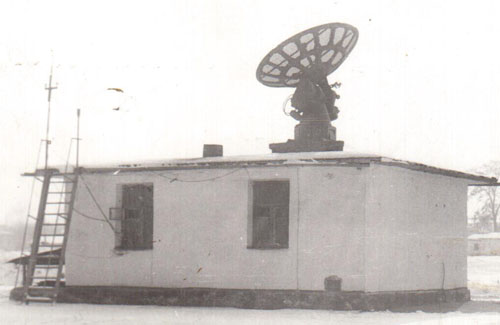
subject was Radar Stations, taught by Vilen Zinovievich Katsnelson and
Deputy Director Nikolai Petrovich Belov. We studied the circuitry of
the "Malachite" radio theodolite, "Meteorit-2," and the MRL-2 radar.
The textbooks were once classified manuals for American WWII radars
(e.g., SR-457) copied and produced in the USSR. The teaching method
focused on rote memorization rather than understanding principles, an
approach I later questioned.
|
|
Other unique
subjects included:
Aerology - Taught by the remarkable Yuri Alexandrovich Gilgner, a
mountaineer and former airship engineer.
Meteorology - I remember little beyond stratocumulus clouds.
Fieldwork - We conducted snow surveys around Kuchino, leading to a
humorous complaint from a local resident who thought we were "dividing
the land."
This broad and rare curriculum proved invaluable later in my career,
for instance, when developing avalanche search systems.
|
|
Summer
Expedition to Liepaja.
|
|
The third year
ended, and summer vacation began. In the technical school there was a
tradition among students to go to Dixon Island to work as loaders,
unloading cargo—a well-paid job due to the northern coefficients, but
ultimately numb and monotonous. I always remembered lines from the
biography of my favorite childhood writer, Jack London: After
graduating from elementary school, he worked at a cannery and left, as
he put it, “not to become a working beast.”
|
|
My schoolmate,
Volodya Kalyonov, who worked at the Institute of Earth Physics, offered
me a place on a summer expedition to Liepaja, Latvia, to assemble
electronic boards for gravimeters. This was almost a direct application
of my specialty. I rightly chose the expedition. A truck is a stupid
job. Take this, get that. It was money, but it was mind-numbing work.
In early July, we started from Moscow on the Minsk highway towards the
Baltic Sea.
|
|
We drove from
Moscow to Liepaja in a GAZ-69, stocked with equipment and a strategic
25-liter flask of alcohol. We based in a old house, with a lab
downstairs and living quarters upstairs.
|
|
The work
involved soldering electronic boards (using 155-series microchips and
P210 transistors) for gravimeters and accelerometers. The work culture
was relaxed initially, and we spent much time on the beautiful city
beach, drinking fresh "Centchu Alus" beer.
|
|
We tested
equipment at the Liepaja lighthouse, which was also an excuse to
"acquire" delicious freshly salted herring and smoked cod from the
adjacent fish factory.
|
|
The expedition
included memorable team-building events, like a trip to a Finnish sauna
in Grobiņa, where we barbecued and swam in the river.
|
|
The core work
involved sea trials on the hydrographic vessel GS-275. My job was to
map the ship's route using Loran navigation. The experience was
professional and rewarding, despite my seasickness. The food provided
by the sailors was excellent.
|
|
Life in Liepaja
was also educational in other ways, learning from seasoned expedition
members about more than just electronics.
|
|
This expedition
provided far more valuable professional experience than manual
labour—practical skills, exposure to new systems, and crucial
interpersonal experience.
|
|
The expedition
ended on September 20, 1973, and I returned to Moscow for my final
year, enriched by a summer of real-world application of my studies.
|
|
|
|
|
|
|
|
|
|