WWW.BOLGOV.NET
|
Vladimir
Bolgov
|
Spitak. Armenia. Earthquake.
How I worked as a lifeguard in Spitak.
|
These notes about Spitak were written
in 1990, almost in fresh tracks. I bring them here without any changes
as it actually was.
|
On
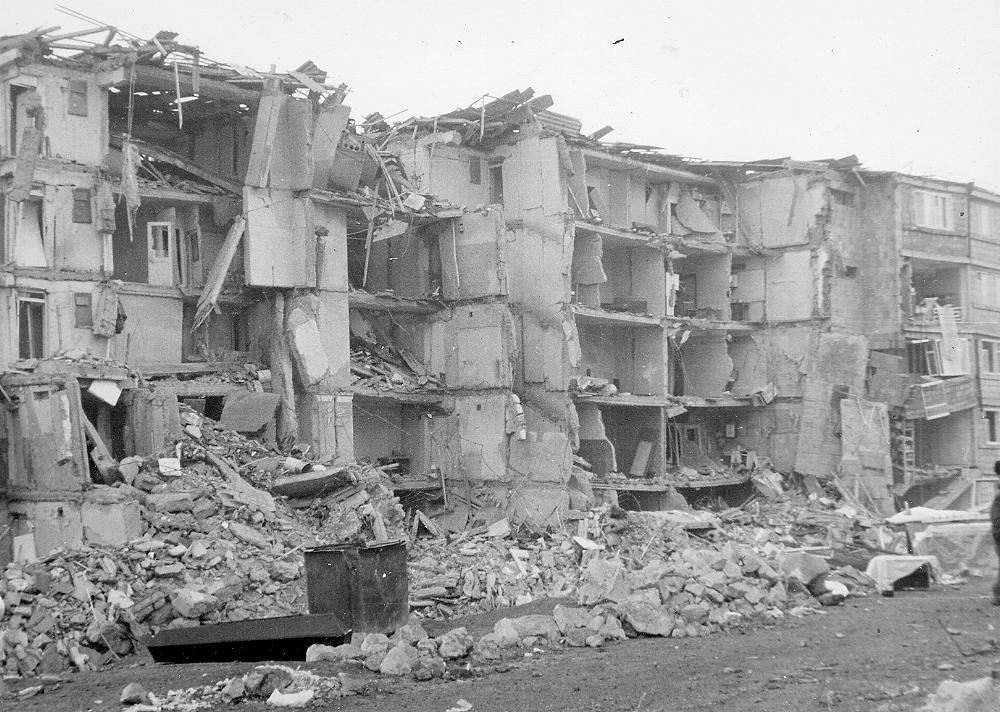
the seventh of December 1988, an earthquake struck Armenia. The first
information about this event in the TASS message was kept in a spirit
that did not cause much concern. Yes, earthquake, yes, victims. First
of all, life support facilities for people are restored. But later, it
became clear from recent reports that such a tragedy has not happened
in our country for a long time, since the Tashkent earthquake of 1968
and the Ashgabat earthquake in 1948.
|
|
On the eighth
of December in the evening, Borya Abramkin, an instructor of the
Balashikha Tourist Club, my friend, called. Said he was organizing a
rescue team and offered to take part in the case. I agreed. It's
probably tomorrow. That's what we decided. Tomorrow, it was Friday or
Saturday, and I can’t remember now, I was at work, doing classes with
students. At recess, Danya came and said that we are flying to Armenia
tonight, and it is necessary to arrive at the Balashikha tourist club
by 6 p.m.
|
|
My students,
hearing about this, were very happy, because there will be no classes
in my subject for several days. And the "best students" even suggested
that there, they say, will soon start epidemics, and Bolgov, i.e. me,
may stay for a long time, and another teacher will give them three
points. It should be noted that these predictions were not destined to
come true, and three people left the walls of the technical school
immediately after the New Year, without completing the course of study.
|
|
The
administration of the college met me halfway and I was allowed to be
absent from work for a week.
|
|
After work, I
drove home, packed my backpack, my clothes, my food and went to the
tour club. There the people were already gathered and there was a bus
that was supposed to take us to the airport. With him from special
equipment were probably only shovels and climbing equipment. After all,
only with a great stretch, our group could be called a rescue squad -
or better, a group of tourists who can exist in difficult climatic
conditions, physically well prepared and able to work with their hands
and live in tents in any weather.
The main organizer of the whole event was Borya Abramkin. He negotiated
with the airport and arranged everything. He said that the plane will
take off at 9-10 hours, from Chkalovskoye airport, near Star City, near
Balashikha.
|
|
At the airport,
we settled in the room where the duty officer is. The plane turns out
to be leaving in the morning, so we'll wait almost 10 hours. We're in
the break room. There's a TV. During the program "Time", half an hour
showed how to land at the airport of Yerevan, planes from different
countries with help. We spent the night in chairs. At 5 a.m., we were
told it was time to get to the plane. There were few people tonight. A
lot of people came this morning.
The commander of the plane built everyone square and gave a small
lecture on how to behave in flight. The main thing is not to smoke,
since the plane recently carried the wounded from Afghanistan, and the
oxygen cranes may not be completely closed everywhere, and oxygen may
accumulate, and ticked a match and fly down. The day before, it was
reported that a Yugoslav plane crashed while landing in Yerevan.
|
|
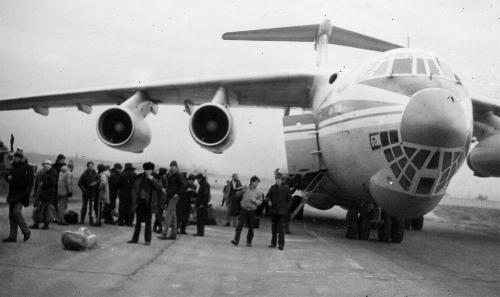
Our Il-76,
cargo plane. People got 60-70. All can be divided into 4 groups. The
first group of builders is the working class. Then the officers, the
third soldiers, the Armenians who were released home and the fourth, we.
11 of us.
|
|
Let's get on
the plane. And it already has a bus brand "PAZ", a crane, a field
kitchen and many boxes.
There were people along the walls where they could. Our only woman,
Olya Verkhova, was the only one on the plane, was invited to the
cockpit.
Let's go. After a while, someone smoked, in the cabin of the bus
builders drink cognac. It's just like people.
|
|
The flight time
is 3 hours, and landing at Zvartnots airport in Yerevan. Get off the
plane. It's different than in Moscow. The sun shines, the blue sky, the
tops of the mountains in the snow. Our plane is on the outskirts of the
airfield, ahead of several cargo aircraft. Soon we begin to help unload
the aircraft builders. Where to go is not yet clear and not known.
|
|
On the grass
there are mountains of shoes, clothes, it is good that there is no snow
and rain. After unloading the plane, we take our backpacks and go to
the reception headquarters, which is probably what it is called. It's
in the airport office space. Crowd, people. Borya found out that the
transport is bad, look for yourself. I asked some boss, where there is
a long-distance phone, to call Moscow. I have to tell you that we flew
safely. But the chief said that communication with Moscow is only with
the authorities, all other phones are disconnected. We went with
Volodya Chiriev to the airport building. Some were let into the
building, found a pay phone, and quietly for 15 kopecks called to
Moscow. I couldn't say there was a phone in the airport. While Boria
was looking for transport, they walked around the airport. Planes from
different countries are constantly landing. You can go anywhere and fly
anywhere you want. There are no border guards or customs officers on
the field. There are idle people of Armenian nationality.
|
|
Around a
mountain of stuff, medicine. How much will be stolen, stolen! No
monitoring, no accounting. Finally, the transportation was decided. We
get on the bus that takes English rescuers to Kirovakan, go with them.
20 of them. We left the airport at lunchtime. In Yerevan, armored cars,
soldiers with machine guns are on the streets. First time in Yerevan.
Gradually the city ends and the bus moves towards Kirovakan.
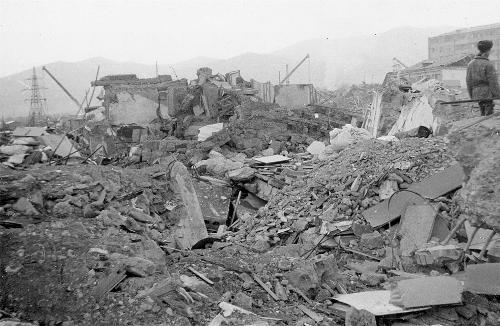
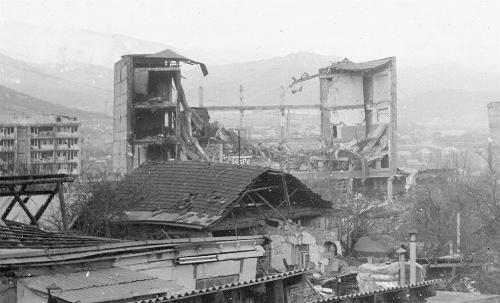
They entered Spitak when it was getting dark. It's creepy. Just ruins.
But that's the way to Kirovokan. The bus stops in the city center. Near
the hotel. We were taken to dinner. We sat at two big tables. At one
table the Soviet people, at the other the British. There's meat for
dinner. We're waiting. We barely ate anything all day. And in the
distance carry cognac and champagne in a small separate pot. Life goes
on as usual.
|
|
After dinner,
we take the bus back to Spitak. We'll work there. After talking in the
center, we went to the location. It's right next to the bakery, right
in front of it. Dark. Lights are burning in some places. We set up
tents, make a fire. Our neighbors are Muscovites. There was Vlodya
Kurlov. A little further the French with their large camp.
Make tea. Mineral water tea. There's no other water. In the following
days, soups and everything else were made from mineral water.
|
|
Day three.
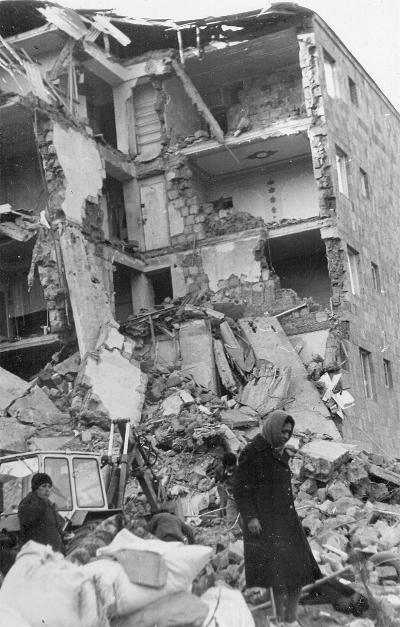
They started working the next day. We get to the center in a passing
car. We're working in an area called Cheremushki. There are only ruins
from the five-story buildings.
The job is to manually disassemble the rubble. Nearby locals, and maybe
not locals. They dig up carpets and other clothes. Clear organization
of work, purposeful - no. Whoever finds a job, works there.
|
|
The following
days are somehow mixed in memory, and then there are excerpts from the
memories.
On the way back to the camp, they helped to load things for one family,
they went to Yerevan to visit relatives. The old man and his son. A
gift was given - a three-liter jar of apricot compote. She was safely
crushed in the evening. We worked there the next day. And on the second
day, going to lunch, along the way saw how the locals are trying to get
things from under the ceiling, under which lay a sofa and things. One
of the residents asked for help getting it. The ceiling fell apart. No
quality of construction work.
In the evening, after dinner, we went with Volodya Chiriev to look at
the bakery. All the work stopped there tonight. The equipment around
him was full, some of the equipment I had never seen. This bakery was a
terrible sight - huge crumpled structures.
|

|
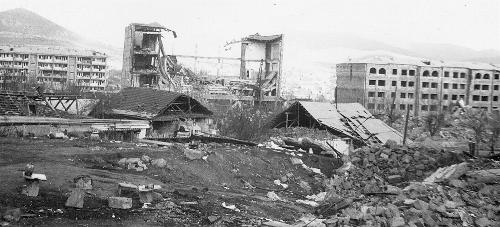
Then two days
worked in the center, not far from the telegraph, or rather what was
left of it. Disassembled rubble, five-storey houses. First the fifth
floor, then the fourth, then the third and so on until the first. Each
crop represented a layer 90 centimeters thick. Mixed with concrete
things, the remains of household utensils. The survivors lived here,
basking by the fires.
|
|
Also, to help
clear up the rubble, residents of Yerevan came by bus. We worked with
one such group once. Interesting observations: They dismantled the
house that was opposite the bank (two-storey), in the first floor of
which there was a savings bank. There were also two young Armenian
women who lived here, packing their belongings. They began to
disassemble their apartment, or rather what was left of the apartment.
Here, the Yerevan people pulled out of the garbage documents, passport,
savings book, money, those young Armenian women. The money started
counting. I wonder why. Not theirs. They talk to each other about
something, they can divide.
|
|
Then, in the
same place, I see the following picture. Yerevan from the stones takes
out a box in which chains are stored, opens, sees the chain, throws the
chain away, and the hostess shows an empty box - they say there is
nothing there. I'm so crazy, in business, in country. And another
microphone was turning out of the phone tubes. He will come to the
phone, pick up the phone so casually, unscrew the microphone, pinch the
fist, then put the tube on the ground, and slowly the microphone in his
pocket. We watched this picture with Volodya Chiriev, before our eyes
the Yerevan man twisted three pieces like this.
|
|
In general, the
disorganization was complete. Where to work, where to work carefully,
where in the first place – nothing is known. Only the policemen who
guarded the ruins of shops from looting did their job. After all,
anyone could drive to Spitak by car.
|
|
Once with
Volodya Chiriev decided to go to the commandant of Spitak, the general,
to express their proposals. But on the way, we were asked to
disassemble the ruins of a one-story house. Pull out the old granny's
bag. He and his son-in-law were picking. In general, they worked well,
dismantled all the ruins, pulled everything out. We never talked to the
general.
|
|
At lunch, you
could get food that was handed out in the center of Spitak directly
from the car. Canned food, bread, free. And again. Some have plenty,
some have nothing. Some grandmother who sits on his ruins and leaves
his last things - nothing. And some of them carry huge waxes.
|
|
On the
penultimate day they worked in a garment factory near the bakery. There
had to be loaded into cars fabrics that were in a destroyed warehouse.
These fabrics, and even imported ones, were full. How many of them were
stolen, only God knows. Formally, at the entrance to the shop there was
a sentry - a soldier. In theory, he was supposed to keep records of
leaving cars, but no one paid attention to him. Next to this post was
brought and stood a new diesel power plant. But it could not be
launched, as it was removed from some parts, without which it can not
work. And that's next to the sentry.
|

|
The fabrics
were loaded into MAZ dump trucks that came from Krasnovodsk, on the
other side of the Caspian Sea, from Turkmenistan. For half a day loaded
10 cars and took to the warehouse in Kirovokan. Here we go. And the
warehouse refuses to accept. They say no, they're stealing everything.
What a mess. And the weather was beginning to deteriorate. Unloaded
everything right at the entrance to the warehouse, under the canopy and
behind another batch.
They decided to leave the next day. We're here tonight. We went to the
fork of the road. We're waiting for transit. The policeman stopped the
Zhiguli. The officer with the machine gun said not to give the driver
any money. They took us straight to the airport.
|
|
We went to
headquarters at the airport. They told us to go to the airfield, and
which plane will be in the direction of Moscow - sit down. We took our
backpacks and went looking for a plane. The first one flew somewhere,
either to Ukraine or Belarus. The second was on our way - flew to the
Tver region, to the air force base near Tver. Military transport
aircraft were returning empty from Yerevan, and there were no problems
with seats in the cargo hold.
Booted. Waiting for takeoff. Pilots are normal people. Before Yerevan,
they had a flight somewhere to Africa, either Mozambique or Guinea. But
we have the ultimate goal of Moscow. There were no planes in Chkalovsk.
Nobody asked for any documents, especially tickets.
|
|
Here we go. We
fly with a landing to refuel the aircraft in Zaporozhye. Not much fuel.
In Zaporzhye, when maneuvering on the runway, hit the end of the wing
with a mast of lighting, and the lantern that at the end of the wing
crumbled. We can't go any further. We're waiting for an emergency team
from Tver. A day later, an AN-24 aircraft with a repair crew arrived.
The crew unloaded us, loaded us, refueled us and we flew to Tver. After
lunch, they arrived safely at the air base near Tver. We got on the bus
and went to the railway station in Tver. There's an electric train to
Moscow. This is the end of the trip to Armenia.
|
|
Conclusions can
be drawn endlessly.
The country was not prepared for such a disaster. And none at all.
Two years before Armenia, there was Chernobyl.
|
|
|
|
|
|
|
|
|
|
|
|
|
|
|
|
|
|
|
|
|
|
|
|
|
|
|
|
|
|
|
|
|
E-mail:
vladimirbolgov@gmail.com
|

|

|
|
|
|
|